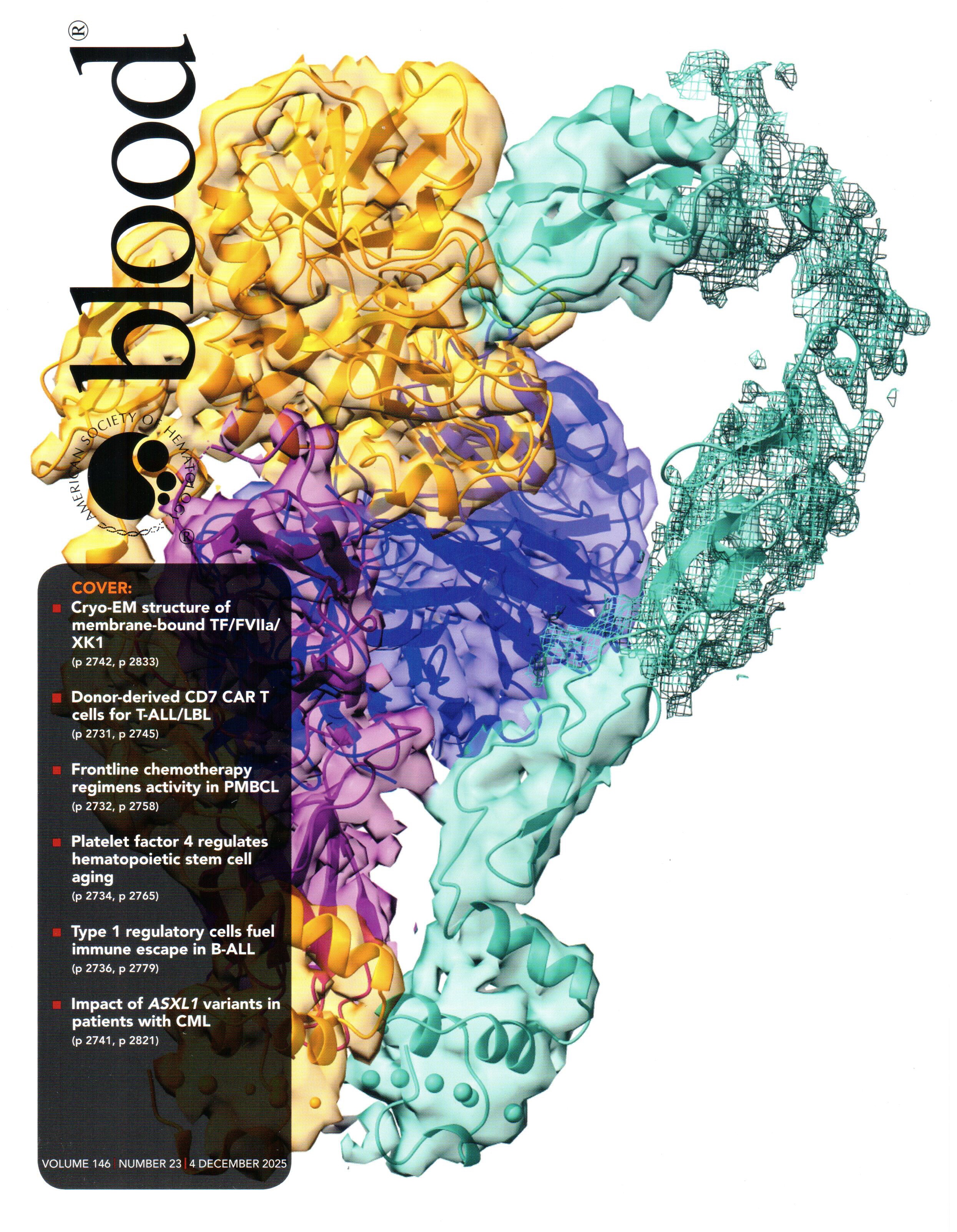
The activation of coagulation factor X (FX) is arguably the most important step in the formation of blood clots. When tissue is damaged by external injury, FX activation is usually initiated by the formation of a complex between FVIIa and tissue factor, which binds and activates FX after anchoring into cellular membranes rich in anionic lipids and calcium. This key step involves the formation of a tripartite complex on the membrane, which was earlier modeled by Resource researchers and published in Blood Advances. In collaboration with the Morrissey lab at the University of Michigan, the previous model is now confirmed by a new, and first, cryo-EM structure of the tripartite complex on the membrane, a study reported as a cover story in Blood.
The Future of Biomolecular Modeling
Quantum Biology and Polyenes-When Theorists and Experimentalists Unite
Announcements

Seminars
Remembering Klaus Schulten
Recent Publications All Publications
- Drug-bound outward-facing conformation of a heterodimeric ABC exporter suggests a putative mechanism of drug translocation. Nat. Commun., 16:10403. 2025.
- Roles of the membrane-binding motif and the C-terminal domain of RNase E in localization and diffusion in E. coli. eLife, 14:RP105062. 2025.
- Ca2+ Stoichiometry Controls the Binding Mode of the PKCα C2 Domain to Anionic Membranes. J. Phys. Chem. B, 129(39):9893–9903. 2025.
- A to-do list for realizing the sequence-to-function paradigm of proteins. Curr. Opin. Struct. Biol., 93:103119. 2025.
- Voltage sensor conformations induced by LQTS-associated mutations in hERG potassium channels. Nat. Commun., 16:7126. 2025.
- Cryo-EM structure of the tissue factor/factor VIIa complex with a factor X mimetic reveals a novel allosteric mechanism. Blood, 2025.
- An Orchestrated Interaction Network at the Binding Site of Human SERT Enables the Serotonin Occlusion and Import. Biochemistry, 64(16):3652–3662. 2025.
Highly Cited
Click here for other highly cited papers